A decibel (dB) is a way of comparing two quantities on a logarithmic scale. For sound, it compares the pressure of a sound wave with a fixed reference: 20 micropascals, roughly the quietest sound a healthy young ear can detect. That reference is 0 dB.
That's the definition. What makes decibels confusing is the logarithmic part, so let's deal with that.
Why a logarithmic scale?
Human hearing covers an enormous range. The loudest sound you can stand without pain has around a million times the sound pressure of the quietest you can hear, and a million million times the energy. Writing that on an ordinary linear scale would mean numbers from 1 to 1,000,000,000,000.
A logarithmic scale squashes that range into something manageable: 0 to about 130 dB. Each step of 10 dB means ten times more sound energy.
It also happens to match how we hear. Our sense of loudness works roughly logarithmically too, which is why decibels feel intuitive once you know the rules of thumb.
The rules of thumb
| Change | Sound energy | Sound pressure | How it sounds |
|---|---|---|---|
| +1 dB | ×1.26 | ×1.12 | Barely noticeable |
| +3 dB | ×2 | ×1.41 | Just clearly noticeable |
| +6 dB | ×4 | ×2 | Noticeably louder |
| +10 dB | ×10 | ×3.16 | About twice as loud |
| +20 dB | ×100 | ×10 | About four times as loud |
So "twice as loud" and "twice the energy" are different things. Twice the energy is +3 dB, which you can just about notice. Sounding twice as loud takes about +10 dB, which is ten times the energy.
This is why the 3 dB rule matters for hearing. A sound 3 dB louder carries twice the energy into your ears, so the safe listening time halves. See how loud is too loud?
Adding decibels
Because decibels are logarithmic, you can't just add the numbers.
- Two equal sources add 3 dB. Two vacuum cleaners at 70 dB each make about 73 dB, not 140.
- Ten equal sources add 10 dB. Ten 70 dB machines make about 80 dB.
- A quieter source barely adds anything. A 70 dB source plus a 60 dB source is about 70.4 dB. Once one sound is 10 dB quieter than another, it hardly changes the total.
That last point explains why turning off the loudest thing in a room makes such a difference, while turning off a quieter one often seems to change nothing.
For the curious, the formula for combining sources is: total = 10 × log10(10L1/10 + 10L2/10 + ...).
Distance and decibels
Outdoors, sound from a single small source (a machine, a person, a speaker) falls by about 6 dB every time you double the distance. A sound measuring 90 dB at 1 m is about 84 dB at 2 m, 78 dB at 4 m and 72 dB at 8 m. Indoors, reflections from walls make it fall off more slowly. A long, straight source like a busy road falls by about 3 dB per doubling instead.
dB, dB(A), dB SPL: what's the difference?
- dB SPL (sound pressure level) is the physical level compared with the 20 micropascal reference, with no adjustment for hearing.
- dB(A) is the same thing, filtered to match how sensitive human hearing is at different pitches. It's the figure used for hearing safety and most noise rules.
- dB(C) and dB(Z) are other filters, useful for bass and analysis. dBA vs dBC vs dBZ has the details.
Decibels turn up elsewhere too: in electronics, radio signal strength and audio gear. The idea is the same (a logarithmic comparison to a reference), but the reference is different, so a "dB" on an amplifier isn't the same as a dB of sound in the room.
See it for yourself
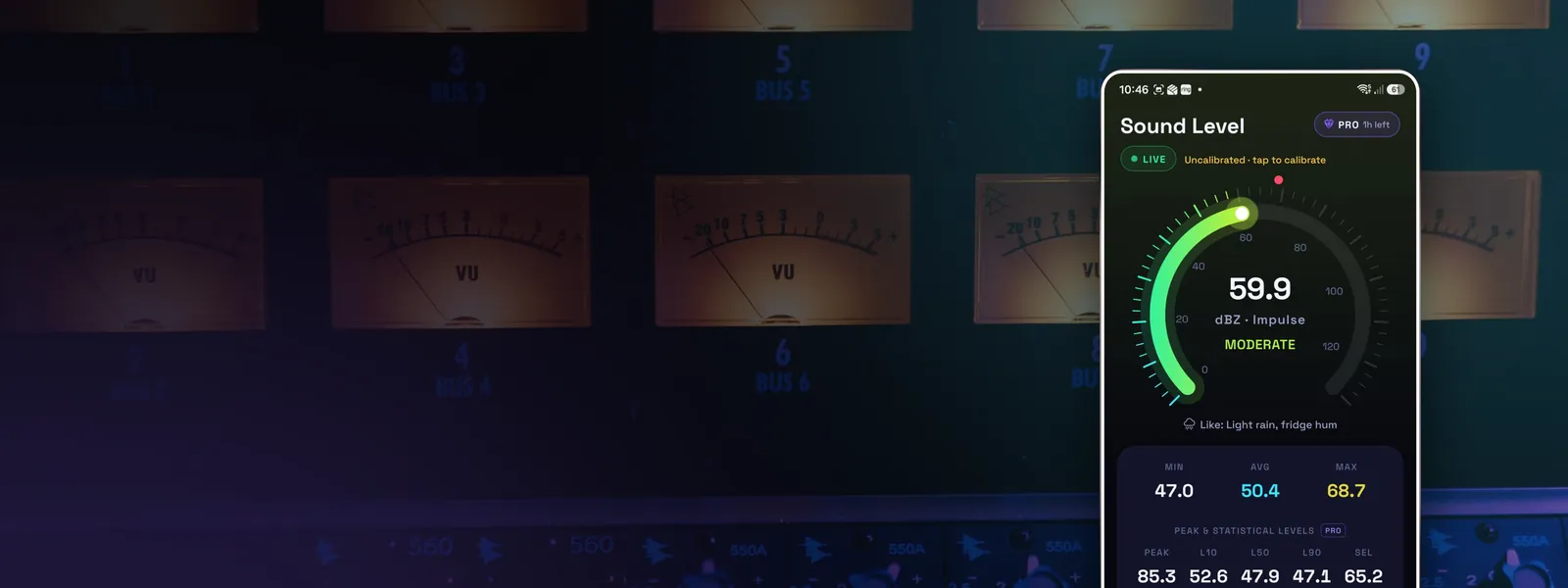
The easiest way to get a feel for decibels is to measure familiar sounds. Try a quiet room, a conversation and the kettle, and compare with our decibel chart.
Try the free online decibel meter in your browser for a quick reading, or work out your daily noise dose.