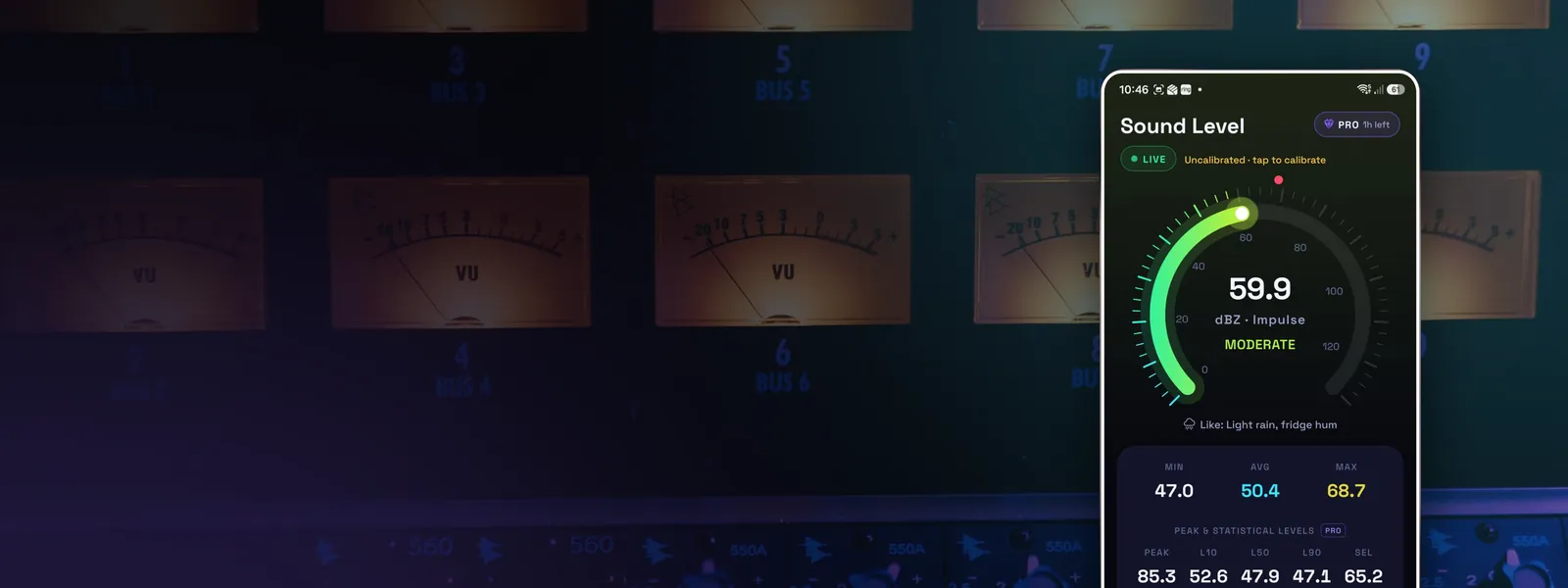
A number like "75 dB" doesn't mean much on its own. This chart puts typical sound levels next to sounds you already know, so you can tell at a glance whether something is quiet, loud or a risk to your hearing.
All the figures are A-weighted decibels, dB(A), which is how sound level meters estimate loudness as people hear it. They're typical values at a normal listening distance. Real sounds vary a lot with distance, the room and the particular machine, so treat them as a guide rather than an exact figure.
The decibel chart
| Level | What it sounds like | Examples |
|---|---|---|
| 0 dB | Threshold of hearing | The quietest sound a young, healthy ear can detect |
| 10 dB | Barely audible | Normal breathing, a soundproof studio |
| 20 dB | Very quiet | Rustling leaves, a ticking watch, a whisper at 2 m |
| 30 dB | Quiet | A quiet bedroom at night, a whisper nearby |
| 40 dB | Calm | A library, a quiet office, a quiet residential street at night |
| 50 dB | Moderate | Light rain, a fridge humming, a quiet suburb by day |
| 60 dB | Lively | Normal conversation at 1 m, background music, an air conditioner |
| 70 dB | Loud | A vacuum cleaner, a busy street, a washing machine on spin |
| 80 dB | Very loud | Heavy traffic at the kerb, a food blender, a hair dryer close up |
| 85 dB | Hearing risk begins | Busy restaurant at peak, a noisy factory floor, heavy city traffic |
| 90 dB | Harmful over time | A petrol lawn mower at the handle, a motorbike passing, a shouted conversation |
| 100 dB | Dangerous | A nightclub dance floor, a chainsaw, a hand dryer at ear level |
| 110 dB | Extreme | Front rows at a rock concert, a car horn at 1 m, an ambulance siren |
| 120 dB | Threshold of pain | A thunderclap overhead, a jet taking off nearby, a loud stadium |
| 130 dB+ | Instant damage possible | Fireworks or a gunshot at close range, a jet engine at 30 m |
What the levels mean for your ears
There are two ways noise damages hearing: loud sound over a long time, and very loud sound for an instant.
- Below 70 dB(A) is safe however long you're around it.
- Around 80 to 85 dB(A) is where long, regular exposure starts to cause harm. The US National Institute for Occupational Safety and Health (NIOSH) recommends no more than 8 hours a day at 85 dB(A).
- Every 3 dB more halves the safe time. That means 88 dB(A) is safe for about 4 hours, 94 dB(A) for 1 hour and 100 dB(A) for only 15 minutes.
- Above about 120 dB, short bursts can damage the inner ear straight away.
Our guide to safe decibel levels goes into this in more detail, and the noise exposure calculator works out your daily dose if you're exposed to several different levels.
Why 80 dB isn't "twice as loud" as 40 dB
Decibels are logarithmic. Each 10 dB step is ten times more sound energy, and to most people it sounds roughly twice as loud. So:
- 70 dB sounds about twice as loud as 60 dB, and carries 10 times the energy.
- 80 dB sounds about four times as loud as 60 dB, and carries 100 times the energy.
- Two identical machines running together are only 3 dB louder than one.
If that feels strange, what is a decibel? explains the scale without the maths.
Distance changes everything
Every figure in a decibel chart assumes a distance. Outdoors, sound from a single source drops by about 6 dB each time you double the distance. A lawn mower that measures 90 dB(A) at the handle might be 78 dB(A) at 4 m and around 66 dB(A) at the end of a long garden. Indoors, reflections from the walls mean it drops off more slowly.
That's also why you'll see different numbers for the same thing online. One source measured a hair dryer at arm's length, another right next to the ear.
How to check your own sounds
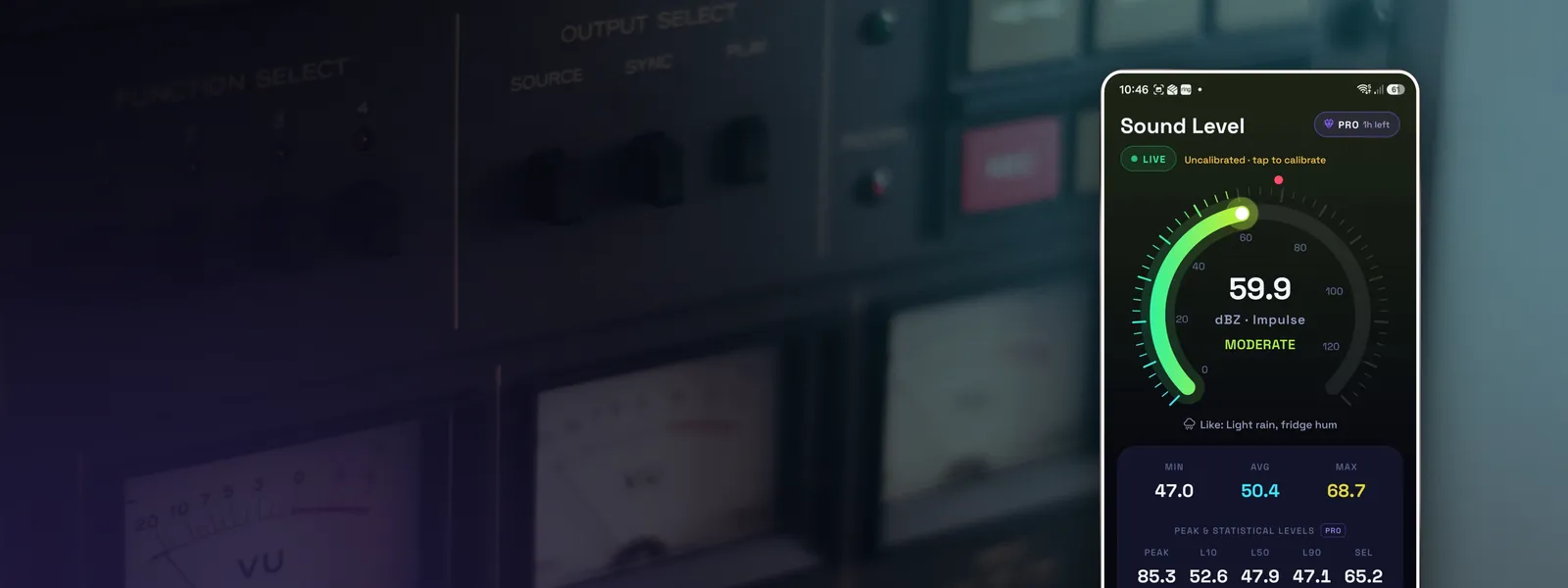
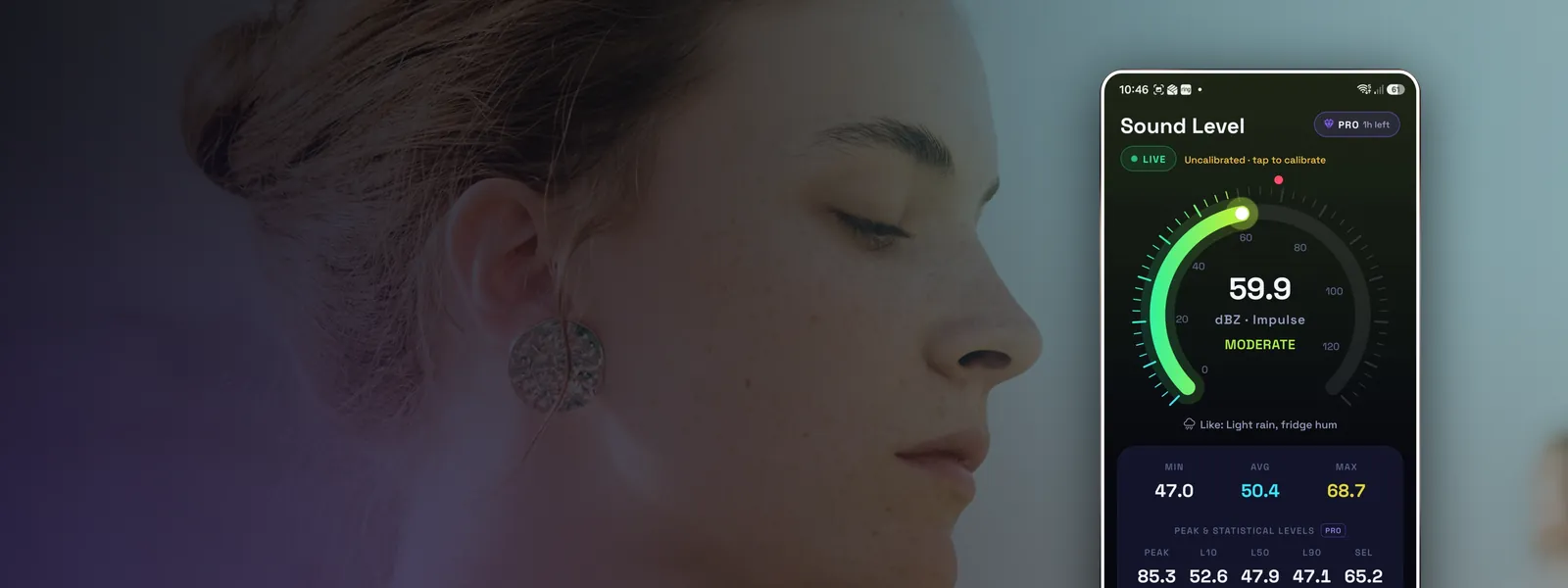
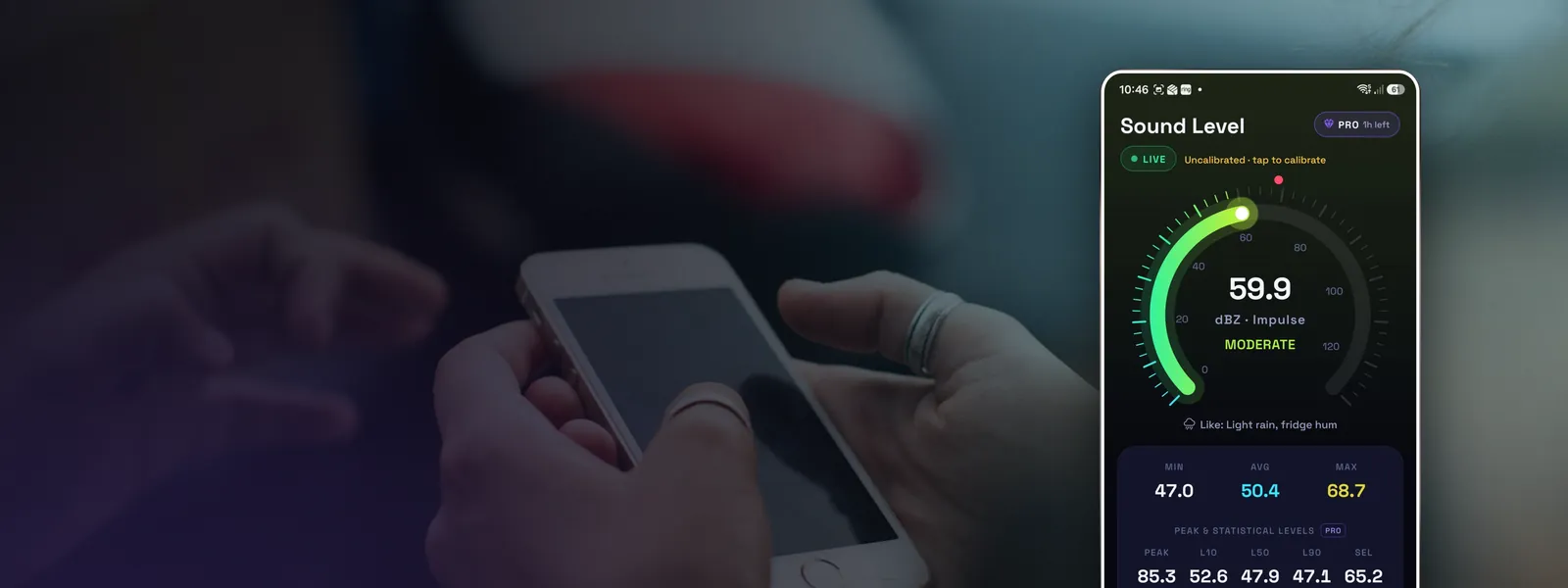
The quickest way to know how loud something really is, is to measure it. A sound level meter app on your phone will give you a reliable everyday figure if it measures properly. Hold the phone where your ears would be, keep it still, and look at the average over 30 seconds or so rather than a single moment. Our step-by-step guide on how to measure decibels with your phone covers the details.
Try the free online decibel meter in your browser for a quick reading, or work out your daily noise dose.