A low hum is one of the most maddening noises there is. It's often quiet, hard to locate and seems to come from everywhere at once. The trick that works best is to stop listening for where it is and measure what pitch it is. Many hums have a frequency that points straight at the cause.
Why hums are hard to locate
Low-frequency sound has long wavelengths: about 3.4 m at 100 Hz and nearly 7 m at 50 Hz. Our ears struggle to tell which direction such sound comes from, and in a room it reflects off walls and forms "standing waves", so it can be loud in one corner and nearly vanish a step away. Hums also travel easily through a building's structure, so the source may be in another room or next door.
Use a spectrum analyser
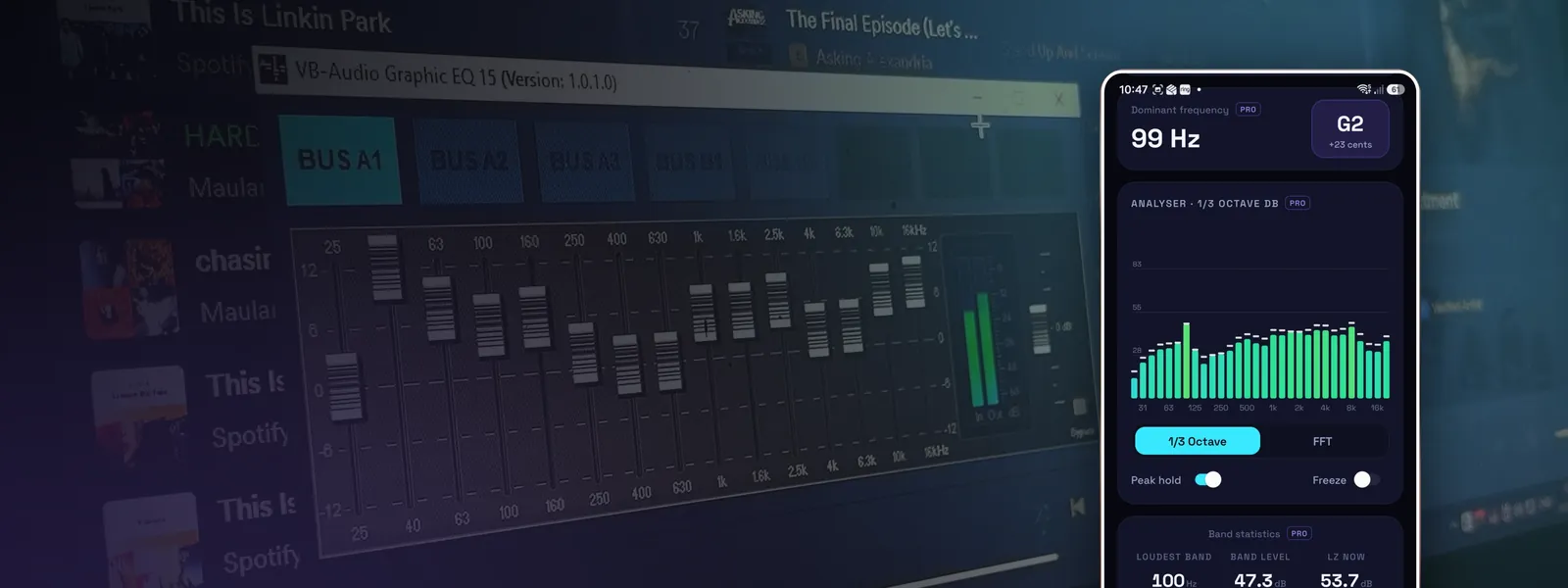
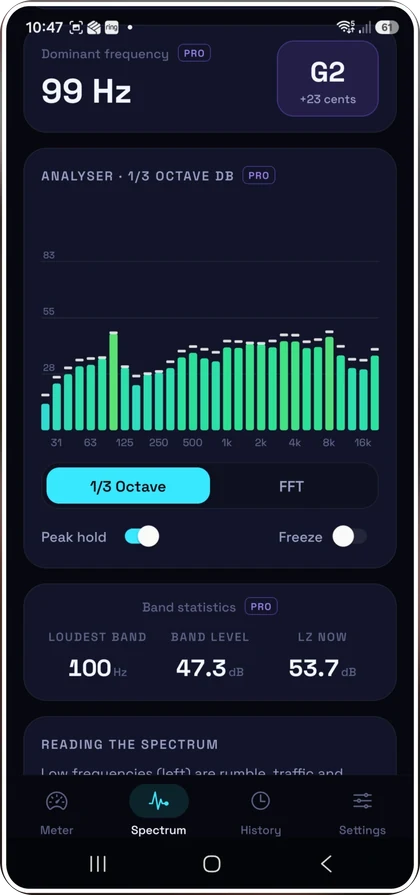
A spectrum analyser splits sound into its frequencies and shows which ones are strongest. To use one on a hum:
- Go to the room where the hum is worst, at a quiet time.
- Open the analyser and let it run for 20 to 30 seconds. Turn on peak hold if your app has it.
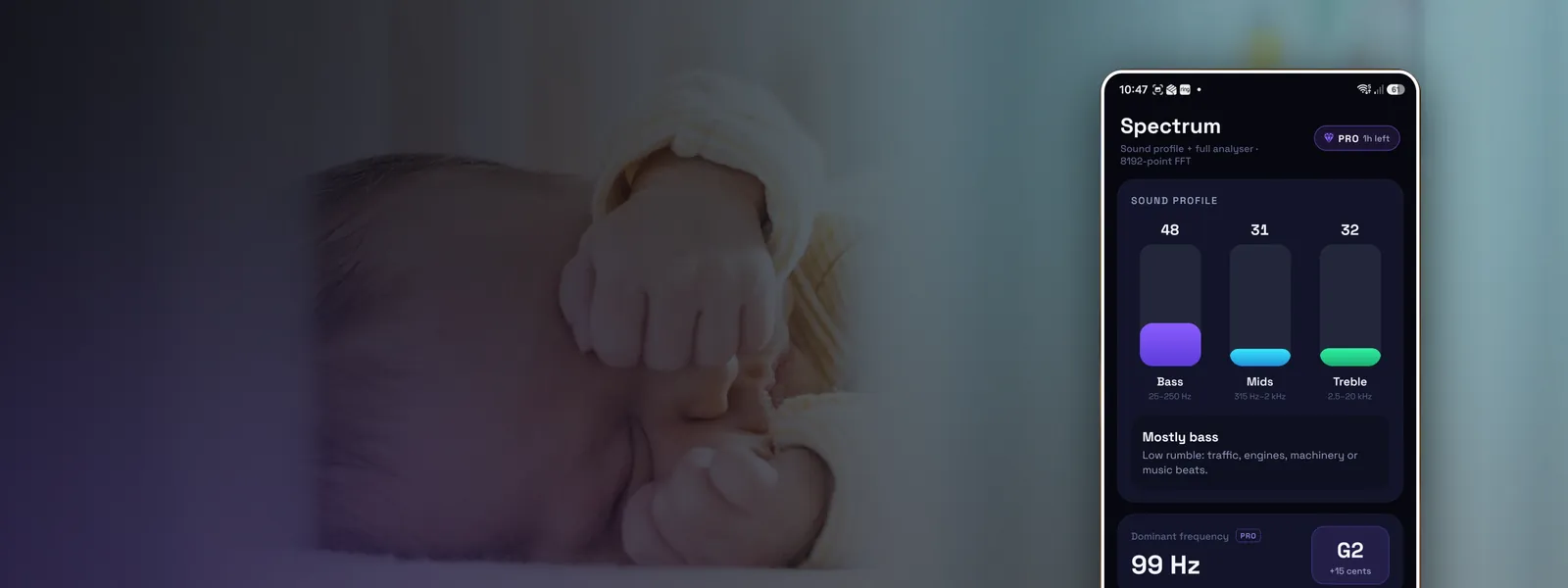
- Look for a narrow, steady spike that stands out from everything else. Note its frequency. Many analysers also show the nearest musical note, which is handy for describing it.
- Turn things off one at a time, watching for the spike to disappear: the fridge, the boiler, chargers, the router, the extractor fan, then the electrics circuit by circuit at the fuse box if you're comfortable doing so.
Common hums by frequency
| Frequency | Likely sources |
|---|---|
| 50 Hz (UK and Europe) / 60 Hz (US) | Mains electricity: motors, fans, older fluorescent lights, poorly earthed audio equipment |
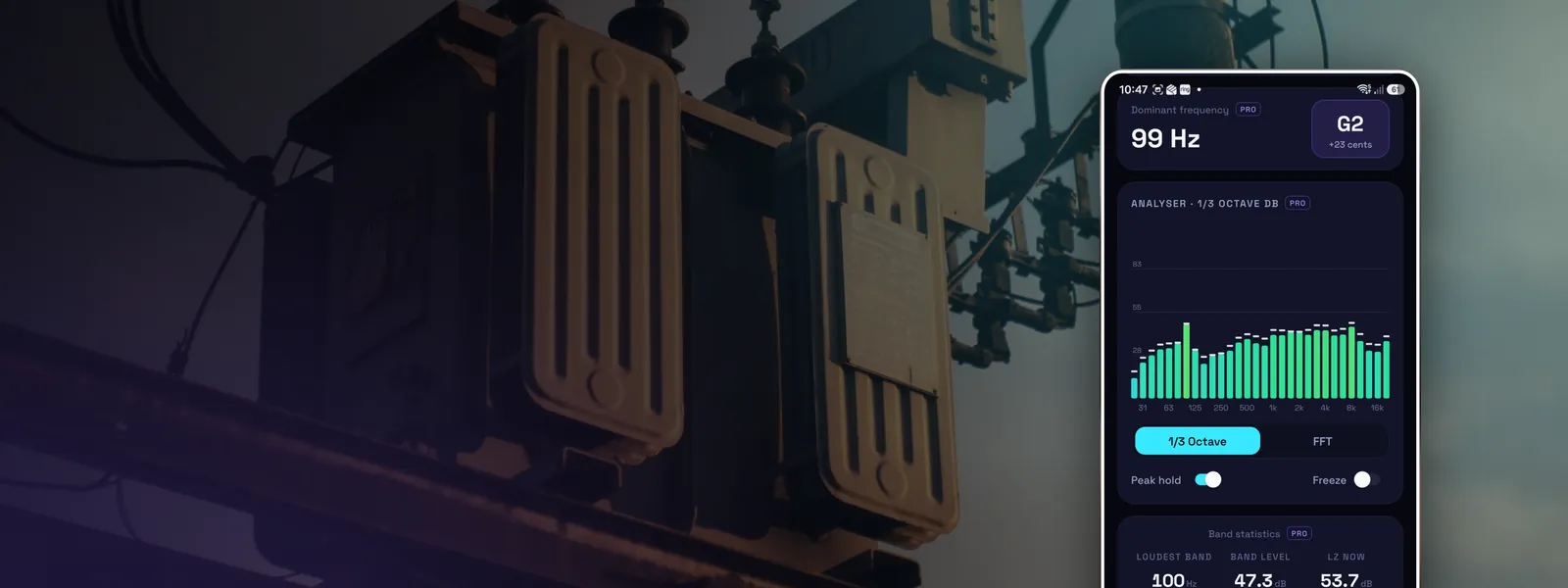
| 100 Hz (UK and Europe) / 120 Hz (US) | Transformers and power supplies (they vibrate at twice mains frequency), substations, chargers, dimmer switches, LED drivers |
| 30 to 60 Hz, steady | Central heating pumps, boiler fans, washing machines on spin, extractor and ventilation fans |
| 40 to 200 Hz, cycling on and off | Fridge and freezer compressors, air conditioning units, heat pumps |
| Changing slowly with traffic | Heavy vehicles, trains, buses idling, distant industry |
A 100 Hz hum shows up on a musical-note display as about G2. In the US, 120 Hz sits between A♯2 and B2. If your analyser keeps landing on these, look for anything with a transformer or a mains-powered motor.
Things that commonly cause a hum
- The fridge or freezer, especially an older one or one touching a wall or cupboard.
- Central heating circulation pumps, which can hum through pipes into every room.
- Air source heat pumps and air conditioning units, yours or a neighbour's.
- Electricity substations and pole-mounted transformers nearby.
- Extractor fans and ventilation systems, particularly mechanical ventilation units in loft spaces.
- Mains-powered gadgets: aquarium pumps, chargers, dehumidifiers, network equipment.
Often a hum gets much louder when a vibrating machine is touching something that acts like a speaker: a wall, a floor joist or a kitchen cabinet. Moving it a few centimetres, or putting it on rubber feet, can fix it.
Limits of a phone
Phone microphones are less sensitive below about 50 to 100 Hz, so very deep hums will read lower than they are, and some won't register at all. If you can clearly hear a hum but nothing shows on the analyser below 50 Hz, the microphone may simply not be picking it up. Try measuring closer to likely sources, or in the corners of the room where low frequencies build up.
Some people hear a persistent hum that no one else can, and that doesn't show up on any measurement. If you've ruled out every source and the hum follows you between rooms or buildings, it's worth mentioning to a GP, as it can sometimes be a form of tinnitus.
What next?
- If it's your appliance: move it, isolate it on rubber mounts, or get it serviced. Pumps and fans often hum louder as bearings wear.
- If it's a neighbour's heat pump or air con: heat pumps installed under UK permitted development rules must meet a noise limit at the neighbouring property. Talk to them first, then the council if needed. Our noisy neighbours guide explains how to log it.
- If it's a substation or utility equipment: contact the network operator, who can check for faults.